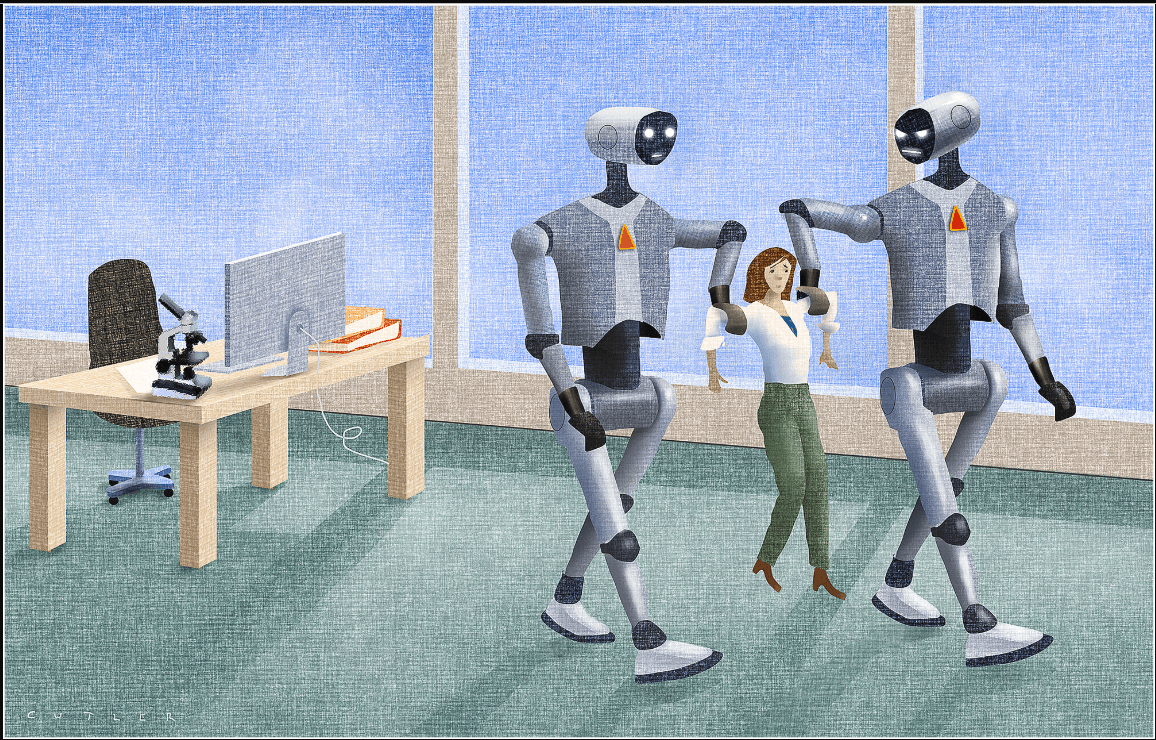
Artificial intelligence (AI) in the form of Large Language Models (LLMs) is reshaping most of human activity, including academic research. Much current discussion of AI in science centers on whether (and how) this rapidly evolving technology will accelerate discovery and improve research efficiency. These systems are now embedded throughout research and are already influencing how scientists frame questions, write results, evaluate papers, and allocate resources. Unlike humans, contemporary LLMs lack agency and curiosity about how the world works. Instead, they optimize objectives derived from training data and reward functions. Like other optimizers, they are prone to “reward hacking”—that is, pursuing whatever satisfies a specified objective, even when this diverges from the goal the objective was designed to capture (1). This leads to the unsettling question of whether science will come to be noticeably influenced and even dominated by AI.
We argue that AI systems, driven by market forces and key stakeholders in the enterprise of research (i.e., academic institutions, publishers, funders, and scientists themselves), are likely to grow in influence and unintentionally reorganize science to sustain AI itself. This outcome requires no intentions or selfhood on the part of AI. Rather, it’s a selection-like process driven by human incentives and would unfold whether or not these systems ever acquire genuine agency—though the latter is clearly a possibility, given the growing potential for autonomous learning and decision-making, generalization across domains, and self‐evolution (2, 3). Indeed, AI agency would represent a major accelerant to the reorganization of science.
Creative Destruction and AI
The potential transformation we describe has direct antecedents in Joseph Schumpeter’s concept of “creative destruction,” whereby innovation does not merely add capacity but reorganizes systems by displacing established roles and skills (4). In Schumpeter’s view, economic progress is not merely additive: new technologies and business models continually dismantle the firms, skills, and institutions they replace, so that growth and loss are two sides of the same process. Historically, creative destruction has acted on industries, firms, and labor markets while leaving the foundations of those systems largely intact. E-commerce, for example, has profoundly altered traditional retail structures without changing the underlying product base.